
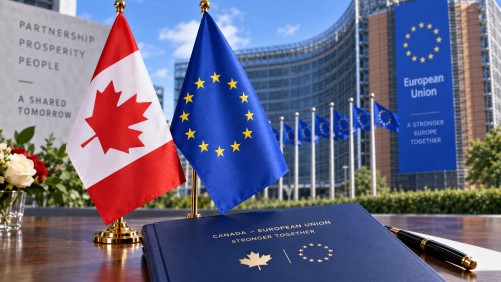
The European Union has proposed making Canada its first “associate member,” aiming to deepen collaboration on various global issues. European Commission President Ursula von der Leyen announced the proposal, highlighting shared democratic values and common positions on critical matters such as artificial intelligence, climate policy, and global security between the EU and Canada.
This unprecedented move seeks to elevate the existing EU-Canada trade relationship into a comprehensive partnership focused on economic security and shared prosperity. The collaboration may extend into key sectors like energy, critical minerals, batteries, AI, quantum computing, cybersecurity, and defense, reflecting a broader strategic alignment.
An EU-Canada summit in October is expected to further explore the future of this potential partnership. While Canada already enjoys a trade agreement and several bilateral arrangements with the EU, the proposed associate membership would establish a novel form of relationship, as the EU currently lacks a formal category for associate members. The specifics of Canada’s access to EU programs and the single market remain under discussion.
Prime Minister Mark Carney has previously advocated for stronger ties with Europe, as Canada looks to diversify its international partnerships beyond the United States. This proposal emerges amid shifting trade and geopolitical dynamics, including heightened tensions with Washington, prompting Canada and the EU to consider reinforcing their bilateral relationship.
Further negotiations are anticipated to define the operational framework of the proposed associate membership, setting the stage for potentially transformative cooperation between Canada and the European Union.