
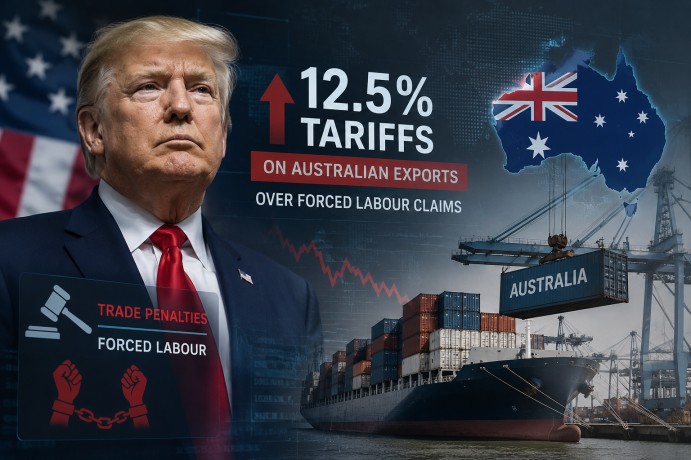
The United States has introduced a new 12.5% tariff on several Australian exports, citing concerns over Australia’s efforts in preventing goods produced through forced labor from entering the supply chain. The decision has been met with strong opposition from Australia’s government, which has labeled the tariffs as unjustified and contrary to the terms of the Australia-U.S. Free Trade Agreement. Trade Minister Don Farrell emphasized Australia’s robust laws against forced labor and modern slavery, urging the U.S. to reverse the tariff implementation immediately.
The tariff affects a broad spectrum of Australian exports, although some major categories such as beef, gold, certain agricultural products, aircraft parts, and specific mineral and industrial goods have been exempted. Australian officials have expressed their dissatisfaction, arguing that the U.S. decision lacks sufficient evidence and warning that it could potentially damage bilateral trade relations. The move has also drawn criticism from business groups and industry leaders, who have described it as unfair and detrimental to Australian exporters.
The tariffs are part of the Trump administration’s broader strategy to expand trade measures concerning forced labor enforcement, impacting numerous countries. This development has sparked a debate on the measures’ effectiveness and fairness, especially given Australia’s established legal framework against labor exploitation.
In response, Australian authorities have pointed out that their country maintains some of the world’s strictest regulations against forced labor and modern slavery. They argue that these tariffs could undermine the spirit of cooperation established under the Australia-U.S. Free Trade Agreement, a sentiment echoed by various industry representatives who fear the negative economic impact on Australia’s export sector.